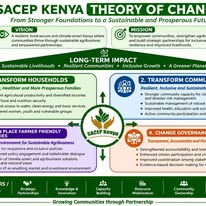
How change happens
Our theory of change
When households transform and communities gain strength — backed by farmer-friendly policies and good governance — the result is sustainable livelihoods and resilient food systems.
Transform households
Every change starts at home. We work with households on kitchen gardens, nutrition, organic inputs and small enterprises so families eat better, earn more and depend less on a single crop or a single rain.
Leads to: food-secure families with skills, income and confidence.
Transform communities
Households acting together achieve what no family can alone: nurseries, water harvesting, producer groups for markets, communication trees for early warning. We help communities organise, contribute local resources and own the result.
Leads to: organised communities that manage their own development.
Put in place farmer-friendly policies
Gains at household and community level need support from above to last. We carry farmer priorities into county forums and public participation processes so plans and budgets reflect what smallholders actually need.
Leads to: county decisions that back, rather than bypass, small farmers.
Change governance
How land, water and markets are governed decides who benefits from them. We support community-level governance of shared resources and accountable local leadership.
Leads to: resources managed fairly, for everyone, for the long term.
Sustainable livelihoods and resilient food systems — the outcome all four pillars build toward.